TL;DR: Incline Village delivers a year-round luxury lifestyle built around a community-owned ski mountain, four restricted-access beaches, two golf courses, a 37,000-square-foot recreation center, and Nevada's no-state-income-tax structure. But beach privileges, parcel classifications, and shoulder-season realities vary meaningfully from one property to the next. This guide walks through what each season actually looks like for an Incline Village homeowner, and what to verify before you buy.
Most buyers can picture the postcard moments. The Lake Tahoe sunrise over Sand Harbor. A blue-bird ski day at Diamond Peak. A boat day off Ski Beach in July. What's harder to picture is the rhythm of an actual year here, and at the $2M+ price point, that rhythm is what you're really buying.
I work with buyers and sellers across Incline Village, Crystal Bay, and Truckee, and the question I hear most often during a first showing is some version of "what's it actually like to live here?" The honest answer is more nuanced than a feature list. Incline Village is a system. The four IVGID-managed beaches, the community-owned ski mountain, the two golf courses, the trail access, and Nevada's tax structure all interlock in a way that shapes how you'll use the home. Some of those pieces are tied to your specific parcel. Some shift dramatically by season. And some quietly compound, year after year, into the case for why this remains one of the most resilient luxury markets in Tahoe.
Here's what year-round Incline Village ownership actually looks like, and what matters most to verify before you buy.
What Is Year-Round Life Like in Incline Village?
Year-round life in Incline Village centers on four lifestyle anchors: Diamond Peak ski resort, four restricted-access beaches on Lake Tahoe, two golf courses, and a year-round recreation center. Add Nevada's no state income tax and a Washoe County property tax structure favorable to long-term owners, and the result is a community designed for active, multi-season use rather than seasonal vacancy.
That's the short version. The longer version is that Incline lives differently than a resort town because it isn't one. It's a residential community of roughly 8,000 year-round residents on the Nevada north shore, with infrastructure managed by the Incline Village General Improvement District, known locally as IVGID. The district handles water, sewer, trash, and the amenities that define the lifestyle.
For luxury buyers, that distinction matters. You aren't moving into a resort. You're moving into a small mountain town with private-club-style amenities baked into ownership.
Why Parcel Classification Defines Your Incline Village Lifestyle
In Incline Village and Crystal Bay, recreation privileges are tied to your specific parcel rather than to a flat membership. Each qualifying residential parcel is issued IVGID Recreation Passes (formerly called Picture Passes) and Recreation Punch Cards. Most standard Incline Village parcels carry full privileges, including beach access. Crystal Bay parcels generally carry the full slate of recreation amenities (Diamond Peak, Recreation Center, golf, tennis, pickleball) but not beach access. A small number of edge cases warrant extra attention.
The structure traces back to the original 1968 beach deed. Per IVGID Ordinance 7, only parcels located within the district boundary as of June 4, 1968 and currently paying the Beach Facility Fee are eligible for beach access. Most Incline Village parcels qualify. Most Crystal Bay parcels do not. For Crystal Bay buyers, this is the single most important detail to internalize: you get the mountain, the rec center, and the courses, but not Burnt Cedar, Incline, Ski, or Hermit.
There are two important exceptions inside Incline Village itself. First, several lakefront parcels along Lakeshore Boulevard hold private deeded lake frontage and do not include full IVGID community beach privileges. Some lakefront owners purchase a second qualifying parcel specifically to secure full beach access. Second, a small number of properties marketed as "Incline Village" technically sit outside the IVGID district boundary and carry no IVGID privileges at all.
In every transaction I represent, I verify privileges in writing before we go under contract. I've seen buyers fall in love with a Crystal Bay home assuming it included beach access, or write strong offers on Lakeshore properties not realizing they'd want a second parcel for community beach privileges. None of this is hard to confirm. It just has to be confirmed. It's the kind of detail that separates a transactional agent from one who actually knows the Nevada-side Tahoe communities.
Winter: Why Diamond Peak Changes the Math
Winter in Incline Village revolves around Diamond Peak, and Diamond Peak is unlike most ski resorts in Tahoe. With 1,840 vertical feet across 655 acres, it's the fourth-most-skiable-vertical mountain in the Tahoe Basin. But the more relevant detail for homeowners is structural: Diamond Peak is community-owned, operated by IVGID rather than a national resort group like Vail or Alterra.
That changes the experience in three concrete ways. First, lift lines are short. Roughly half of skier visits come from local residents, which keeps the mountain feeling like a neighborhood asset rather than a destination. Second, parking-lot-to-lift access is easy enough that a ski day doesn't need to be a full-day production. You can grab two hours before lunch and be back at your desk by 11. Third, revenue from the mountain flows back into the community, funding upgrades across all IVGID facilities rather than into a national company's shareholder reports.
For luxury buyers who've owned in larger resort markets, the contrast is striking. You can ski mid-week with no crowds, then walk into a Recreation Center that feels more like a private club than a public facility. The Rec Center itself is a 37,000-square-foot facility with a 25-yard indoor pool, sauna, fitness equipment, and group classes, which means winter routines stay intact on days when the mountain is closed or the weather isn't cooperating.
Shoulder Seasons: The Quiet Argument for Year-Round Use
Spring and fall are the seasons most outside buyers never see, and they're often the seasons full-time owners love most. The pace slows. Restaurant reservations open up. The trails empty out. And the lake takes on the kind of glass-water mornings that you don't get in July.
The Tahoe Rim Trail provides 165-plus miles of hiking, equestrian, and mountain biking terrain encircling the lake, with trail conditions generally best from July through mid-October. Closer to home, the Incline Flume Trail runs from Mt. Rose Highway down to Tunnel Creek and gives you a high-elevation route with sustained lake views, all within minutes of town.
There's also a part of shoulder season most marketing pieces skip. Mud season is real. Some road construction happens in May and October. Restaurant hours shorten. A handful of businesses close for two-week stretches. None of that is a deal-breaker, but it's worth knowing if you're imagining year-round Incline as a continuous string of postcard days. The buyers who do best here are the ones who use the home through the shoulder seasons, not just the marquee months. That's also when the community feels most like itself.
Summer in Incline Village: What Beach Access Actually Means
Summer is when most first-time visitors fall in love with Incline Village, and it's the season where parcel privileges matter most. IVGID manages four restricted-access beaches: Burnt Cedar, Incline, Ski, and Hermit. Each plays a different role. Burnt Cedar combines lake frontage with an outdoor pool, waterslide, snack bar, and paddleboard launch. Incline Beach offers sandy frontage, picnic areas, and a kayak launch. Ski Beach is the boating hub and houses the district boat ramp. Hermit is the quietest of the four, often the favorite of full-time residents.
Access to all of them is gated to parcel-privilege holders and their guests, which is what keeps Incline's summer experience feeling private even in the high season. For comparison, a public Sand Harbor visit during peak summer now requires a vehicle reservation between 8:00 and 10:30 a.m. from May 15 through September 30. As an Incline homeowner with full privileges, you don't deal with that. Your beach day starts and ends on your schedule.
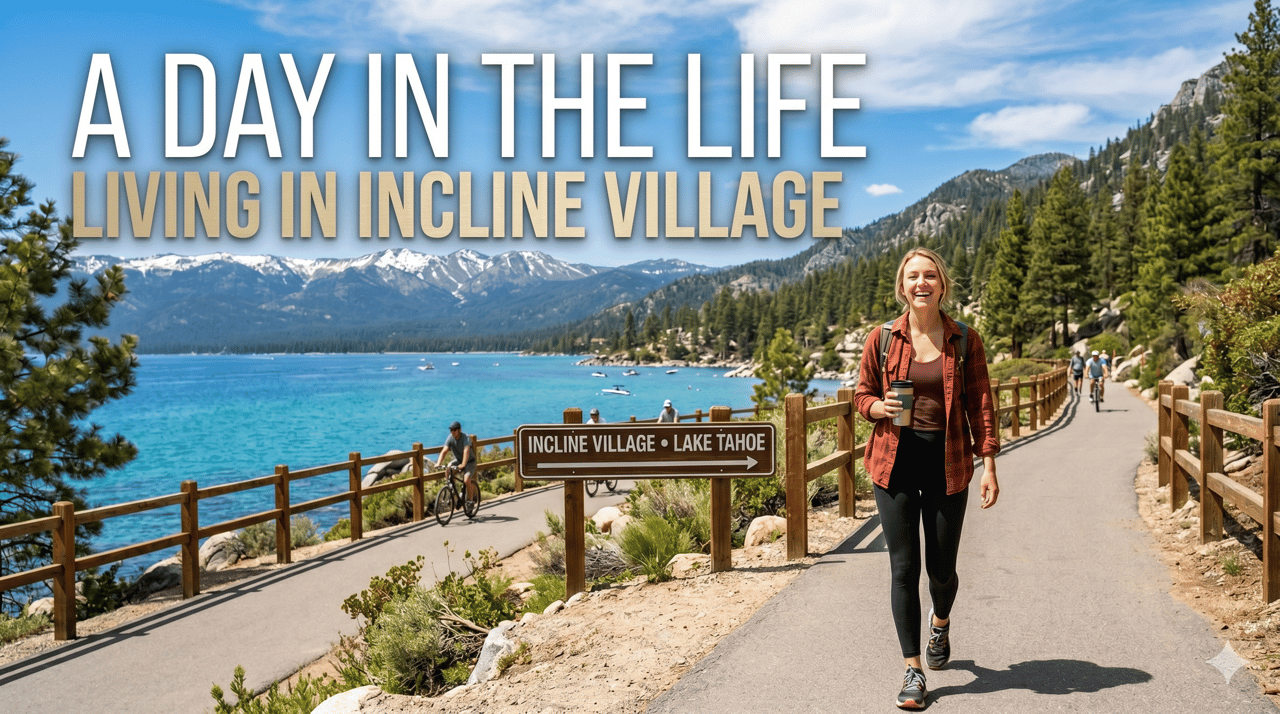
One useful detail I share with most clients: even on the busiest Sand Harbor weekends, pedestrian access via the Tahoe East Shore Trail doesn't require a reservation. The trail is a 3-mile paved bike and walking path connecting Incline Village to Sand Harbor, open from one hour before sunrise to one hour after sunset. If you've ever tried to drive into Sand Harbor on a July Saturday, you'll understand why this single piece of infrastructure quietly improves the summer ownership experience.
What Year-Round Ownership Actually Costs
Beyond the purchase price, year-round Incline Village ownership typically includes Washoe County property taxes in the range of 0.6 to 0.7 percent of assessed value, the annual IVGID Recreation Fee on the same tax bill, and Nevada's significant income tax advantages for those who establish full Nevada residency. Wildfire insurance and seasonal upkeep (snow removal, caretaker services) are the other line items most buyers underestimate.
The headline number for high earners is the state income tax difference. California's top marginal rate exceeds 13%, while Nevada has none. According to recent analysis of Tahoe-area tax exposure, a household earning $300,000 annually can save more than $25,000 per year in state income tax alone by establishing Nevada domicile. For ultra-high earners, the savings scale further. Establishing Nevada residency requires more than just owning a home here: you'll need 183 days of physical presence, a Nevada driver's license, and the standard severing of California ties that a qualified CPA can walk you through.
Property tax mechanics also favor Nevada in the long run. In California, property is reassessed at sale at roughly 1% to 1.25% of purchase price under Prop 13. In Nevada, properties aren't reassessed on sale. Combined with a lower base rate, the long-term carry on a $3 million Incline home runs meaningfully below an equivalent home on the California side.
Two carrying costs I'd flag for any out-of-area buyer: wildfire insurance has tightened across the western U.S., and Incline is no exception. Most luxury homes are insurable, but premiums and underwriting requirements have shifted. For second-home owners, budget for a seasonal caretaker and snow removal service. These run a few thousand to several thousand per winter depending on the property's footprint and how you use it. I walk every client through specifics during the luxury home buyer process.
Who Incline Village Is Right For (And Who It Isn't)
Incline Village is a strong fit for buyers who want deep year-round use of the home, not just two or three weeks of vacation. It works especially well for Bay Area professionals optimizing for Nevada tax residency, retirees prioritizing low-friction luxury, and families who want a real community with strong schools and a tight social fabric. It's less of a fit for buyers expecting walkable nightlife, an Aspen-caliber dining scene, or the density of a destination resort town.
A few honest tradeoffs worth naming:
- Dining and nightlife are limited. Incline has good restaurants. It does not have a dense food scene. Buyers used to Park City or Aspen often want to know that going in.
- It's a small community. That's a feature for most luxury buyers and a constraint for some. If you want anonymity, this isn't it.
- Truckee offers a different lifestyle. California-side neighborhoods like Martis Camp, Lahontan, and Old Greenwood have more architectural diversity, larger lot sizes, and a stronger summer event culture. They also carry California's tax exposure. If you're weighing both sides of the lake, my honest comparison of Truckee vs. Incline Village walks through the specifics.
The buyers who do best in Incline are the ones who've spent real time here through more than one season before they buy. The ones who struggle are usually those who fell for it on a July weekend and didn't fully grasp the rhythm of the other ten months.
A Typical Week as an Incline Village Homeowner
Abstractions only go so far. Here's what an ordinary week looks like across three different seasons.
A January week. Tuesday morning, the kids are at school by 8 and you're on the Crystal Express chair by 9. Two hours, six runs, back home by 11:30 to finish work. Wednesday is a Rec Center day: lap swim, sauna, indoor pickleball with neighbors. Thursday and Friday are work-from-home days with a late-afternoon nordic loop or a quick hike up the lower flume. Saturday brings a long ski morning, lunch on the Snowflake Lodge deck, and dinner at home with friends in from the Bay Area.
A July week. Mornings start early before the wind picks up on the lake. You walk the East Shore Trail before breakfast, then spend the heat of the afternoon at Burnt Cedar with the family or out on the boat from Ski Beach. Tuesday is a golf day at the Championship Course. Wednesday is the Incline Farmers Market. Friday evening, you're at the Shakespeare Festival at Sand Harbor, having walked in via the trail rather than fighting Highway 28.
An October week. The mountain isn't open yet but the trails are at their best. You bike the East Shore Trail when it's nearly empty. You hike a stretch of the Tahoe Rim Trail and don't see another person for two hours. Reservations open up at restaurants that were booked solid in July. The lake is glass at 7 a.m. You realize this is the season you'd have moved here for, if you'd visited in October instead of July.
That's the case for year-round ownership in one paragraph each. Three different rhythms. One property quietly absorbing all of them.
What This Means for Buyers and Sellers
For buyers, the lifestyle case for Incline Village is strong. But the verification work is where this market separates good agents from average ones. Parcel privileges, neighborhood-specific quirks, wildfire insurability, and the tax-residency planning that maximizes the financial case all matter. None of it is hard. It just has to be done.
For sellers, the same details tell the story buyers need to hear. Listings that lead with finishes and square footage often underperform listings that show how the home lives across the seasons. The most resilient pricing in this market comes from positioning that connects the property to the lifestyle system around it.
If you're weighing Incline Village against other parts of Tahoe-Truckee, I'm always glad to walk through it with you. No pressure, just clarity. You can also browse current Incline Village and Crystal Bay listings, or, if you'd like access to homes that aren't yet on the open market, Compass Private Exclusive inventory is one of the real advantages of working with our team.
Frequently Asked Questions
Do all Incline Village homes include beach access?
Most standard Incline Village parcels include beach access, but there are exceptions. Beach privileges are tied to the parcel under IVGID's recreation ordinance, and eligibility traces back to the original 1968 beach deed. Most Crystal Bay parcels do not include beach access. Several lakefront parcels in Incline Village itself also lack full IVGID community beach privileges because they carry private deeded lake frontage instead. Always verify in writing before going under contract.
What is IVGID and how does it affect Incline Village homeowners?
IVGID is the Incline Village General Improvement District, the local quasi-governmental district that manages water, sewer, trash, and recreation amenities for Incline Village and Crystal Bay. Owners pay an annual Recreation Facility Fee on the Washoe County tax bill, which provides IVGID Recreation Passes for parcel-eligible amenities including Diamond Peak, the Rec Center, two golf courses, and the Tennis & Pickleball Center. Parcels that also pay the Beach Facility Fee receive beach access privileges.
How does owning in Incline Village compare to Truckee or Tahoe City?
Incline Village offers Nevada tax advantages, restricted-access beaches, and a smaller, more residential community feel. Truckee and Tahoe City sit on the California side, which means Prop 13 reassessment on sale and California state income tax exposure, but offer more dining variety, larger lot sizes in communities like Martis Camp, and a stronger summer event culture. The right choice depends on residency goals, lifestyle preferences, and long-term plans for the property.
Is Incline Village a good year-round home or only a vacation home?
It works well for both, but the highest-quality ownership experience tends to belong to buyers who use the home through multiple seasons. The community has a year-round residential base, full-service schools, a 37,000-square-foot recreation center, and infrastructure built for full-time living. Shoulder seasons are quieter and not as marketed, but many full-time residents consider spring and fall the best months of the year.
What are property taxes like for an Incline Village luxury home?
Washoe County property taxes on Incline Village homes typically run around 0.6% to 0.7% of assessed value, with no reassessment triggered on the sale of the property. A $2 million home generally carries a tax bill in the range of $12,000 to $14,000 annually, plus the IVGID Recreation Fee. Combined with Nevada's lack of state income tax, the long-term carrying cost is materially lower than on equivalent California-side homes.
About the Author
Lukas Brassie is the founder of The Brassie Group at Compass, specializing in luxury residential real estate across Incline Village, Crystal Bay, Tahoe City, and Truckee. He has sold over $115 million in residential real estate and has been recognized by Real Trends as one of the top 1.5% of residential agents nationally. Read client experiences.
Last updated: May 2026 by Lukas Brassie.