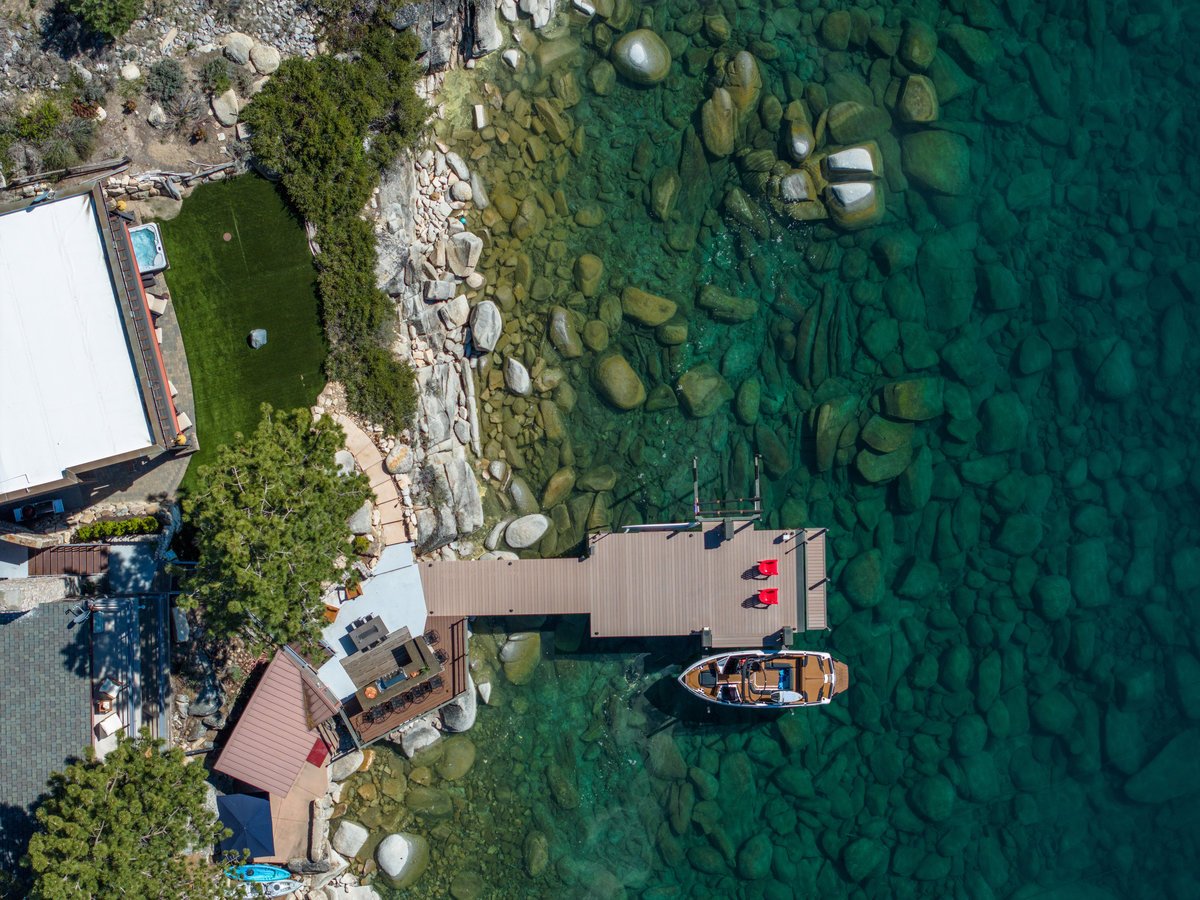
TL;DR: Lakeshore Boulevard is the only Incline Village address where Tahoe's ultra-luxury market actually exists. In 2026 alone, two parcels here changed hands for $125M and $46M, both off-market. What makes a Lakeshore lot worth eight or nine figures is not what's built on it. It's the frontage, the pier and buoy entitlements, the IVGID status, and the TRPA coverage you inherit at closing. Here's how to read the street.
Two of the largest residential transactions in Lake Tahoe history closed in 2026 on the same street. Both were on Lakeshore Boulevard in Incline Village. The first was a $46M off-market deal earlier in the year. The second was the , the new Tahoe record by nearly double.
Records like that get headlines. What they don't explain is why Lakeshore. There are other Incline parcels with frontage. There are gorgeous lakefronts on the West Shore, in Glenbrook, in Crystal Bay, in Tahoe City. But within , a single one-and-a-half-mile stretch of road keeps absorbing the top of the deal flow. The reason has very little to do with the houses.
The questions I get from $20M+ buyers about Lakeshore are almost always the same four. Here's how I'd answer them, in order.
What Makes a Lakeshore Boulevard Parcel Different?
Lakeshore Boulevard is the only Incline Village address where you can buy true Lake Tahoe frontage in any meaningful inventory. The street runs roughly a mile and a half between the Hyatt Regency and State Route 28, and every parcel on the lake side is a littoral lot with direct shoreline. There is no other comparable inventory in Incline.
Below that headline, four things drive value on this stretch: frontage width, the shorezone improvements already on the parcel (pier, buoy field, boathouse), IVGID assessment status, and how much TRPA land coverage the lot carries. Most of the homes on the street were built before 1995. The land carries the value, not the structure.
When a , the listing led with 106 feet of private beachfront. That's the unit of measure here. Not square feet. Not bedrooms. Feet of frontage. Two homes on the same street can trade at very different numbers because one has 60 feet, a buoy, and a covered slip, and the other has 110 feet, a pier, and a transferable boathouse.
This is also why most Lakeshore buyers I work with start by ranking parcels, not properties. The house can be remodeled or torn down. The 60 feet can't be widened.
Two Records, Both on the Same Street
The Jurvetson transaction was the largest single residential sale Tahoe has ever recorded. According to Robb Report, , and the closing bundled in a $7M adjoining parcel. The combined number nearly doubled the prior Tahoe record of $62M, also set in Incline.
The same buyer entity had . Neither home was on the open market when it traded.
When I pull every $2M+ closing in Incline for , one pattern stands out. The count of transactions is normal. The dollar concentration is not. A handful of Lakeshore parcels are doing structural work for the entire ZIP code. If you strip the two Jurvetson closings out, the rest of the year looks like a steady, rational luxury market. Add them back in and Incline reports a record.
That's the punchline on Lakeshore. One street holds most of the assets at a tier the rest of Tahoe can't supply.
What Do Pier Rights and Buoys Convey on a Lakeshore Parcel?
Pier and buoy permits on Lake Tahoe attach to the parcel, not the seller. When you close on a Lakeshore Boulevard home, you inherit whatever shorezone improvements TRPA has already approved. Adding a new pier or buoy after the fact is governed by a lottery and is, in practice, nearly impossible to win on this stretch.
The governing framework is the , codified in Chapters 80-85 of the TRPA Code. New piers are allocated through a pier prioritization process held every other year. Mooring buoys are allocated through an . Buoy fields cannot extend more than 600 feet lakeward, must keep 55 feet between buoys, and must hold a 35-foot setback off each side property line.
Translated for buyers: if a Lakeshore parcel already has a pier and a registered buoy or two, that's a meaningful piece of the price tag. If it doesn't, the realistic path to adding them is years long and uncertain. I always ask the listing agent for the parcel's mooring registration, the pier permit history, and any pending TRPA applications. That paperwork tells you more about future use than any disclosure form.
Do All Lakeshore Boulevard Parcels Have IVGID Beach Privileges?
No, and this is the single most misunderstood thing about the street. Most Lakeshore Boulevard parcels do receive IVGID Recreation Pass eligibility, which is what unlocks and the rest of the IVGID amenity system. A small number of parcels do not. The exception is not visible on Zillow, in the MLS, or in most listing descriptions.
The IVGID beach and recreation fees are assessed parcel by parcel. A long-running citizen audit has documented that and therefore have not received the corresponding privileges. The status can be traced through the Washoe County Assessor's records and IVGID's billing history, but it is not something a casual buyer would catch from a listing photo.
When I listed 1709 Lakeshore Boulevard, IVGID status was something I had to surface for buyers proactively because the standard disclosure stack doesn't flag it cleanly. That's the level of diligence this street demands. If a parcel has full IVGID privileges, the buyer is also buying frictionless access to Ski Beach, Incline Beach, Burnt Cedar, and Hermit Beach as part of . If it doesn't, the home is still spectacular, but the recreation math changes and the comp set should too.
TRPA Coverage and the Rebuild Question
Almost every serious Lakeshore buyer asks the same thing within the first showing. Could I tear it down and build new? The honest answer is sometimes, with conditions, and almost never at the scale you're picturing.
The constraint is . Coverage is the amount of a parcel allowed to be impervious (buildings, driveways, decking, hardscape), and on lakefront parcels it's measured by land capability class. Backshore land is split into Class 1a and 1b, each with its own allowable coverage percentages. A recent walks through real numbers from an actual project: 2,530 square feet of existing 1a coverage, with strict scenic mitigation, sediment-trap requirements, and approved color and material palettes for anything visible from the lake.
Most Lakeshore lots are already at or near their coverage cap because they were built out decades ago. You can sometimes through the Tahoe Conservancy or transfer them from another parcel, but the supply is limited and the process is slow. A demo-and-rebuild on Lakeshore is feasible. A demo-and-rebuild that materially expands the footprint usually is not.
This is why I treat the existing house, on most Lakeshore parcels, as the upper bound of what the site can realistically support. Buyers who plan around that constraint get the right home. Buyers who don't end up in a multi-year permitting cycle.
How Do Buyers Actually Find Lakeshore Boulevard Inventory?
Most $20M+ transactions on Lakeshore Boulevard never reach the public MLS. Both 2026 record sales were off-market. At this tier, sellers value privacy as much as price, and inventory moves through agent-to-agent conversations months before any listing exists. The way buyers get into that pipeline is by being known to the agents who hold the relationships.
In 2025 I closed $42M in Incline Village, #2 at Compass in Incline Village by transaction count. A meaningful share of that was off-market. When I write about , the share I cite from my own practice is roughly one in four. On Lakeshore specifically, the share is much higher. The Tahoe Daily Tribune has documented that did eventually go public, but those are the exceptions, not the pattern.
The practical access path looks like this. Buyers get pre-positioned with a financing structure that can move on a few days' notice, an attorney who knows TRPA and Nevada title quirks, and an agent who's already in conversations with the holders of the parcels they care about. Compass also operates that surfaces a portion of the off-market layer through verified channels. None of this is theatrics. It's how the actual deal flow runs.
What You're Really Buying at $20M+ on Lakeshore
You're not really buying a house. You're buying a fixed-supply asset on the only stretch of Incline shoreline that produces these transactions, plus the entitlements that came with it before TRPA tightened the rules.
The other piece of the math is Nevada. A primary Lakeshore residence sits inside Nevada's tax framework: no state income tax and property taxes around 0.6% of assessed value, with the assessed value increase capped at 3% per year on primary homes. Secondary residences are not capped the same way and can adjust faster, so the residency question matters more for some Lakeshore buyers than others. I work that calculation through with every cross-border client because it changes the carrying cost meaningfully.
Lifestyle compounds on top of all of that. IVGID privileges, two championship golf courses, Diamond Peak, the trail system, and the four district beaches sit inside the same fee structure that funds the recreation system. For buyers comparing tiers, it's worth knowing before committing to the $20M+ stretch. Lakeshore is its own market, and it should be evaluated that way.
Two takeaways for buyers seriously looking at this address.
First, the parcel matters more than the house. Frontage, pier and buoy registrations, IVGID status, and TRPA coverage are the four things that actually drive value, and only the first one is visible on Zillow. The diligence work on the other three is where the wins and the losses get made.
Second, access is a function of being in the conversation before the listing exists. If Lakeshore is on your shortlist, the right time to start that conversation is months ahead of when you'd like to close, not weeks. I'd be glad to walk through current parcel availability, talk through what's quietly active, or pull the IVGID and TRPA records on anything you're already evaluating. when you're ready.
Frequently Asked Questions
How much does a Lakeshore Boulevard home in Incline Village cost?
Asking and sold prices on Lakeshore Boulevard range from roughly $10M for smaller-frontage homes to $125M for the record sale set in 2026. Public listings in the low-to-mid eight figures, like a recent , give a rough range, but most of the deal volume above $20M moves off-market. Price per foot of frontage is the more useful metric than price per square foot at this tier.
Do Lakeshore Boulevard homes come with IVGID beach access?
Most do, but not all. IVGID Recreation Pass eligibility is assessed parcel by parcel by , and a small number of Lakeshore parcels have not historically been assessed. Verifying the status before you write an offer is essential because it materially affects use and resale value.
Can you add a new pier or buoy to a Lakeshore Boulevard property?
In most cases, no. through a pier prioritization process held every two years and an annual mooring lottery. Existing piers and buoys transfer with the parcel at closing, which is why they're a major component of the price. Adding new ones after the fact is unlikely on the Incline stretch.
What's the property tax difference between a Nevada and California Tahoe lakefront?
Nevada property taxes run roughly 0.6% of assessed value with a 3% annual cap on primary residences, and Nevada has no state income tax. California taxes run roughly 1.0-1.25% of assessed value under Proposition 13, with a 2% annual cap. For a $20M+ lakefront, the difference in carrying cost and income tax exposure can be substantial, especially for buyers who can establish Nevada residency.
How do off-market Lakeshore Boulevard listings work?
Most ultra-luxury Lakeshore transactions are pre-marketed through private agent-to-agent networks before any public listing. Sellers value discretion at this price point, and buyers typically learn about availability through agents who already represent owners on the street. The Compass private exclusive inventory and other broker networks are the formal channels; informal conversations between active agents are the larger channel.