The Tahoe Regional Planning Agency describes the rule in language dry enough to skip past. The Bailey system, it says, "prohibits new development on all capability 1 through 3 parcels, and restricts the amount of coverage" on everything else. That single sentence, written to govern soil erosion around Lake Tahoe, is the reason two homes can sell for the same price in the same season and have completely different futures. One can grow a primary suite, a garage, a wraparound deck. The other is already built to its legal ceiling, and no amount of cash changes that.
In June 2026, the typical Tahoe City home was valued near $1.13 million, down roughly 7.5 percent from a year earlier. That number tells you what the market thinks the house is worth today. It tells you nothing about whether you can add 400 square feet to it. For that answer, you need a figure that never makes it into a listing description: how much impervious coverage the parcel is allowed to carry, how much of that allowance is already used, and whether more can be bought from somewhere else in the basin. If you are comparing Tahoe City to Homewood, or to any other North or West Shore address, this is the number that actually separates one market from another.
The Percentage Buried in a 1974 Soil Survey
Every parcel in the Lake Tahoe Basin was mapped and scored back in 1974, when a researcher named Robert Bailey classified the region's soils by how much disturbance they could absorb without sending sediment into the lake. That work became the Land Capability Classification system TRPA still uses today, sorting parcels into seven Land Capability Districts. The lower the number, the more sensitive the soil, and the less you can build.
Under that system, TRPA prohibits any new development at all on the three most sensitive classes, Land Capability Districts 1 through 3. On the remaining four districts, allowable coverage runs on a sliding scale of 1, 5, 20, 25, or 30 percent of the parcel, with the more permissive numbers reserved for soils least likely to erode toward the lake.
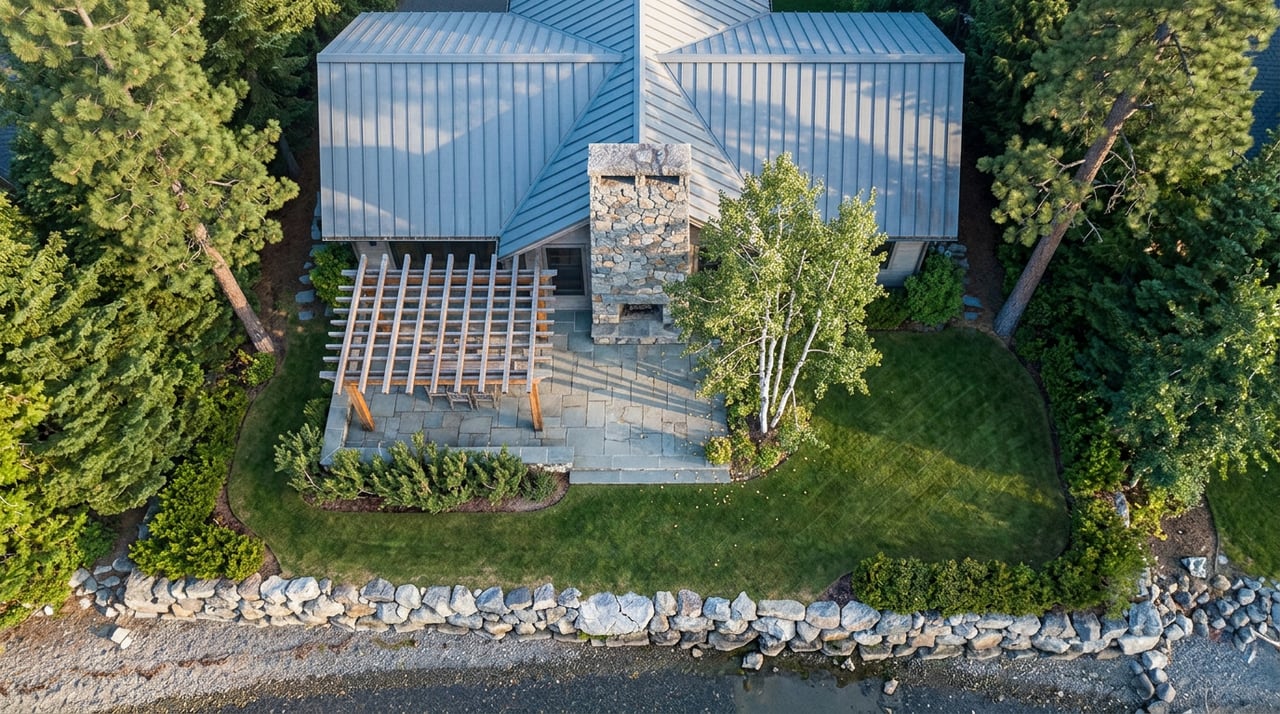
Coverage itself means anything that stops water from soaking into the ground: the house, the driveway, the garage pad, a compacted parking area. Add it up and compare it to the parcel's allowance, and you know whether that dated 1970s cabin has room to become a real remodel or whether it is already sitting at its limit. For homes built before 1987, TRPA offers a Land Capability Verification specifically because so many older structures were never formally scored, and owners often discover the number only when they try to pull a permit.
Why the Address on the Parcel Map Matters as Much as the Bailey Score
Here is the part that makes location inside the basin matter as much as the soil under the lot. TRPA's own coverage rules carve out an exception for parcels inside what it calls a recognized Town Center, the walkable commercial cores the agency wants to see built up rather than spread out. A parcel that qualifies can be eligible for a higher coverage allowance than its raw Bailey score would otherwise permit. That designation is drawn on a map, not implied by an address, so two homes with identical soil scores can carry different coverage limits depending on which side of a boundary line they sit on.
This is exactly why a buyer cannot assume a Tahoe City fixer and a similarly priced West Shore fixer near Homewood offer the same room to grow. Coverage on parts of the West Shore has been described by people who work that side of the lake as effectively unavailable in some pockets, a product of older subdivisions built out under tighter hydrologic zone rules with little left to buy locally. Whether a specific Tahoe City parcel falls inside a Town Center boundary, and how much of a coverage bump that carries, is a question to put to TRPA or Placer County directly. It is not something a listing sheet will answer for you.
When the Lot Is Already Full, You Buy Someone Else's Empty Space
If a parcel has used its allowance, the only way to add square footage is to acquire coverage from another property, and on the California side of the basin, which includes Tahoe City and Homewood, that market runs through the California Tahoe Conservancy's Land Bank Program. The mechanics are specific enough to change how you plan a renovation timeline. A straightforward land coverage transaction is expected to close within about 12 weeks and no later than four months from application. Buying an actual development right, the kind needed to add a full residential unit rather than just a few hundred square feet of impervious surface, is a heavier transaction: up to 16 weeks to close, a one-year outside window, and a non-refundable administrative fee near $800.
None of that happens until after a building permit is already in motion. The Conservancy will not release rights until TRPA has issued a conditional permit, which means the coverage purchase sits inside your construction timeline rather than ahead of it. For a buyer who plans to close escrow and start a remodel the same season, that sequencing alone can add months.
The other limit is geographic. Coverage historically has only been transferable within the same hydrologic area, so a Tahoe City owner short on coverage cannot simply buy a surplus from a lot on the East Shore. You are shopping a local market, and in a built-out town center, local supply is not guaranteed.
The Rule That Could Rewrite the Math, But Hasn't Yet
TRPA has spent recent months reviewing a change that would loosen that geographic restriction, allowing coverage to move across a much wider slice of the basin rather than staying locked inside individual watersheds. The logic behind it is straightforward: water draining from a lot in Incline Village and water draining from a lot on the West Shore both end up in the same lake, so the argument for keeping coverage trapped in narrow zones weakens once you look at it that way. As of this spring, the proposal had not been finalized. It remained under active discussion rather than adopted policy.
If it does move forward, the parcels that stand to gain the most are the ones currently locked out entirely, places like Homewood where coverage has simply not existed to buy locally. A Tahoe City parcel that happens to sit inside a Town Center boundary, with its own larger local allowance already in place, has less to gain from a basin-wide opening than a lot that currently has nowhere local to shop at all. That asymmetry is worth checking before you assume a coming rule change will treat every West Shore or North Shore property the same way.
What to Ask Before You Assume a Remodel Is Simple
Before you write an offer on anything you plan to expand, get four things confirmed rather than assumed:
- Pull the parcel's IPES or Bailey score through TRPA's Parcel Tracker, or request the seller's existing Land Capability Verification if the home predates 1987.
- Calculate current coverage against the allowed maximum. A house that looks modest can already be sitting at its limit once the driveway, garage, and compacted parking areas are counted.
- Ask whether the parcel qualifies for a Town Center coverage bonus, and get that answer from TRPA or the local planning department rather than a listing sheet, since the designation applies to location, not marketing copy.
- If a transfer would be required, find out whether coverage is actually available inside the same hydrologic area before you count on it, and build the Conservancy's stated 12- to 16-week timeline into your renovation schedule rather than your closing schedule.
None of this shows up in a comparative market analysis built from price per square foot. It shows up in a parcel file, a soils map from 1974, and a policy debate that is still being argued out this year.
The Question Worth Asking Before the Comp
Does a home that's already over its coverage limit have to remove anything? No. Existing coverage is grandfathered as long as you leave it alone. The number only becomes a live issue the moment you plan to add square footage, at which point the existing footprint counts against whatever allowance the parcel carries.
Can I find this out before I write an offer, not after? Yes, and you should. A Land Capability Verification or a coverage report from TRPA's Parcel Tracker takes far less time than discovering the limit during a permit review after you already own the house.
A Tahoe City price tag tells you what the market thinks a home is worth this month. It does not tell you what you're allowed to build next. If you're comparing that number against a West Shore listing or a Homewood fixer and trying to figure out which one actually gives you room to grow, that's exactly the kind of parcel-level work the Brassie Group does before a client ever removes an inspection contingency. Let's talk about your highest possible return.